Tuesday, May 17, 2011

UMNO Memakai Syariat Syaitan

http://wargamarhaen.blogspot.com/2011/05/sheikh-dr-wahbah-zuhaili-sumpah-laknat.html

Ahad, 15 Mei 2011

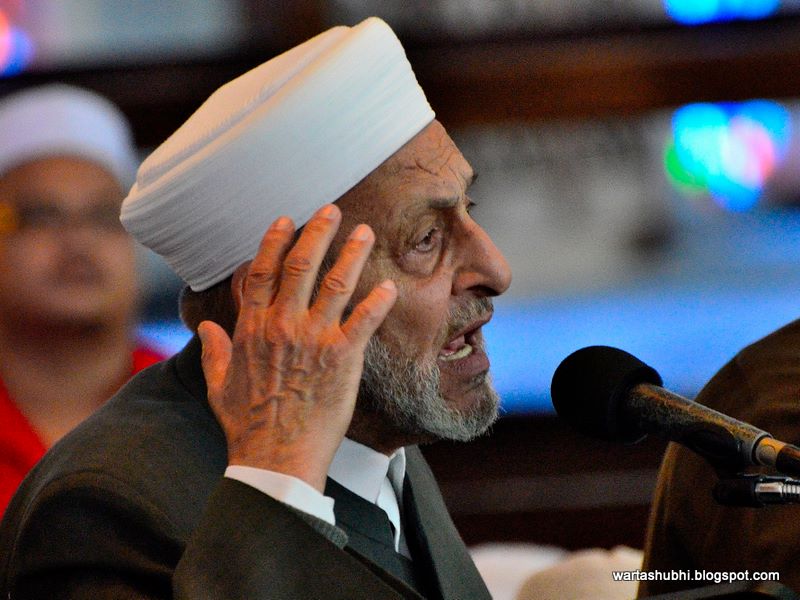
Sheikh Dr Wahbah Zuhaili : Sumpah Laknat Eskay Syariat Syatain,Syariat Syaitan Patut Letak Dibawah Kaki!!!

https://blogger.googleusercontent.com/img/b/R29vZ2xl/AVvXsEh-DDuTumG5lkmwK6bVQd478z1xfR3FOV_AJ8c_BI4DJioBMIhC71yCae7BX1FQyOvJQw0qbiIRgAoffFAaAj1LtuZ8zUFpwiHPpR7snACBWlx6jJi4r3IBA2Dez2-Cd22jGokVHn3SvcwH/s1600/_DSC4955.JPG

Aku terima sms ini daripada temanku yang menghadiri muzakarah oleh Sheikh Dr. Wahbah Zuhaili, dan dalam smsnya tertulis:

"Aku baru tamat bermuzakarah oleh Sheikh Dr. Wahbah Zuhaili , Yang diterjemahkan oleh Dr. Zulkifli Al Bakri.

Secara rumusannya Sheikh kata ,hidup manusia banyak ujian , Allah nak tengok siapa yang beriman dan siapa munafik, Sheikh minta kita sabar.

Sumpah mubahalah dalam bab jinayat adalah tidak sah ,biarlah sumpah seribu kali pun .

Sheikh kata dalam kes Video seks dan sumpah Eskay ni fitnah semuanya , dengan tegas Sheikh kata ini semua syariat syaitan , syariat syaitan patut letak bawah kaki.

Akhirnya Sheikh kata , dia kenal Anwar, Anwar ini seorang yang baik dan bersih Sheikh nasihat kepada Anwar supaya mengadu kepada ALLAH S.W.T dan jangan layan hal-hal yang remah ini."

Thursday, March 31, 2011

Salafis seek power in Egypt

http://english.aljazeera.net/video/middleeast/2011/03/2011330201517382483.html

Banned from politics under Hosni Mubarak, the religious movement is trying to shape Egypt's future.
Last Modified: 30 Mar 2011 20:39
For a group that has never taken part in political life, the religious Salafi movement is now emerging as a new force in Egypt.
As they establish a platform based on Islam as a system of governance, however, many secular and liberal activists fear the emergence of a religious state following their country's ousting of long-term leader Hosni Mubarak.
Al Jazeera's Zeina Khodr reports from Alexandria on the ideological battle to fill the vacuum left in the wake of Egypt's revolution.

Tuesday, March 29, 2011

A war of Western imperialism?
Backing of Libyan rebels apparently aims to clean up West's image across the Arab world.
Last Modified: 28 Mar 2011 13:09
Bombing Gaddafi is not a humanitarian gesture, but an attempt to spread goodwill across the Arab world directed at the West, Moor says [GALLO/GETTY]
There is a lot about the Western intervention in Libya that could go wrong – and it remains to be seen whether bombing Gaddafi and his mercenaries is a good decision.
However, large numbers of people around the world appear to support the objectives of the anti-regime forces. Also, the indigenous resistance movement – which requested help – would have been annihilated in the absence of those air strikes.
George Bush’s legacy of destruction extends beyond the piles of brick, flesh and mortar that we have been tallying for a decade now in Iraq and Afghanistan.
More than any other figure in the post-war 20th century, the last American president did more to erode the gains in legitimacy made by supranational institutions and their proponents.
After the Iraq war, the United Nations began to be perceived as a US rubberstamp body – or worse – as a meaningless exercise in bureaucracy.
The UN can only function legitimately through consensus (or consensus-lite) decision-making and it was clear that the US was strong-arming weaker states in 2003.
George Bush and the neoconservatives hijacked the legitimate language of consensus-based intervention for their own ill use.
So activists are not wrong to react cynically when they hear that language today; I don’t believe that bombing Gaddafi is a humanitarian gesture.
But George Bush should not be allowed to delegitimise the mechanisms – which are distinct from the language – of global intervention in situations that offend human rights and dignity.
Today, many people agree that the situation in Libya is horrifying. Furthermore, the Libyan rebels requested aid from the outside world.
Those two conditions alone do not justify intervention but they are crucial components of a legitimate international decision to employ force. 
What is a successful intervention?
The question of what a successful intervention means is a very important one. At the very least, it means taking a back seat and supporting the rebels in the capacity that they desire.
It also means not attempting to install a new government that’s pliant and subordinate to the West. Compromise on these two principles will quickly diminish the legitimacy of the campaign against Gaddafi.
Many people have argued that the intervention is a Western imperialist project. Here, it is worth remembering that Western powers were already in control of Libya’s oil when the revolution began.
Muammar Gaddafi was as much “our guy” as Hosni Mubarak. Condoleezza Rice personally visited Libya and met with Gaddafi in 2008.
The following year Tony Blair pushed for the release of the Lockerbie bomber to secure a sweetheart deal with the Libyan regime (although it was Gordon Brown who did the releasing).
Western powers would have been much better served by backing Gaddafi if oil was their object.
There is an alternative imperialism argument: that the intervention is really a push to consolidate Western control over Libyan resources. But, without intervention the rebels would have most certainly been annihilated by Gaddafi’s superior forces.
So why back the losing horse? How can Western powers be sure they can succeed in creating a more agreeable government? Would not they go with the devil they know, especially when he is already their devil?
Finally, any government that takes shape in Libya in the future will have to address the basic issues that fueled the popular uprising there in the first place.
Gaddafi is an imperial stooge and a new imperial government will ensure that the underlying conditions will not go away.
Spreading goodwill, avoiding oil price spikes
So what’s motivating the Western powers into projecting their power into Libya? And why is the West not intervening in Bahrain or Saudi Arabia or Yemen?
The potential benefit of successfully backing the rebels will be an increase in goodwill across the Arab world directed at the West. It is not clear if that is a realistic expectation, but it is one appears to motivate Western leaders.
Meanwhile, the cost of attacking Gaddafi and his mercenaries in a limited way, and supplying the rebels with arms is relatively low. It is not clear if the cost is actually low, but it’s likely that it is perceived that way since the intervention is already underway.
In Bahrain and Saudi Arabia, the opposite is true. The American president Barack Obama will seek reelection, so it is in his interest to prevent the global economy from stagnating then shrinking.
A successful revolution in Bahrain may destabilise Saudi Arabia which would drive the price of oil up which could cause the US economy to stall. It is just not a risk worth taking for him.
Probably, fears of an insurgent Iran – legitimate or not – play into his calculations as well. That’s because most Bahrainis are Shias.
Likewise, Yemen permits the Americans to pursue Al Qaeda affiliates in that country. That goes directly to Obama’s security credentials.
If Yemen lapses, Obama will be accused, rightly or wrongly, of permitting terrorist sympathizers to take control in yet another Middle Eastern country. And the 2012 election campaign is already underway. 
Intervention in Libya could turn out badly in a many different and unforeseen ways. And imperialism and neoliberal “reforms” – which are a problem in that country – did not arrive with the revolution; they preceded it.
We can aspire towards helping young Libyans reform their society to make it more democratic, just and anti-imperialist. But before they can do that they must survive Gaddafi’s pulverizing onslaught. And that’s something that the Western offensive gives them a chance of doing.

Wednesday, March 23, 2011

Setback for Anwar in Malaysia sodomy trial


High Court decides to admit key DNA evidence against opposition leader, reversing earlier ruling.
Last Modified: 23 Mar 2011 05:24
Anwar Ibrahim maintains there is a political conspiracy against him [AFP]
Anwar Ibrahim, the Malaysian opposition leader, has suffered a setback in his sodomy trial, as a court decided to accept the key DNA evidence that had been earlier rejected as inadmissible.
The country's High Court, on Wednesday, said it would let prosecutors use the evidence in their bid to link Anwar to traces of semen found on his accuser, a 25-year-old former aide.
The surprise reversal of the decision came after an appeal by the prosecution, and after the court had heard new testimony from police.
"It is clear that [Anwar's] arrest was lawful and the detention was for a lawful purpose," judge Zabidin Mohamed Diah told a packed courtroom.
"This court has no choice but to allow these items to be tendered [as evidence]. My earlier ruling in the matter is reversed," he said, but added that the court would not compel Anwar to provide a sample of his DNA.
The court had previously ruled that DNA from a bottle, toothbrush and hand towel in Anwar's detention cell -taken without his consent - was obtained illegally, and was therefore inadmissible.
Vital evidence
The evidence is a vital part of the prosecution's effort to prove that Anwar had sex with Mohamad Saiful Bukhari Azlan, his former aide. A chemist had testified that the DNA on those items matched that of semen discovered on Saiful.
Anwar faces up to 20 years in prison if convicted of sodomy, which is considered a crime in the Muslim-majority country.
Yusof Zainal Abiden, the government prosecutor, had asked the High Court to review its earlier decision about the illegality of the DNA evidence.
He urged the court to compel Anwar to provide his DNA as tests would show whether there was a match with the semen found in an internal examination on Saiful, who claims he was coerced into having sex with the politician at a Kuala Lumpur condominium in June 2008.
Anwar has refused to voluntarily provide a DNA sample because he fears authorities will tamper with it.
The opposition politician criticised the court's decision, insisting to reporters that authorities got the three items through "trickery and deception".
'Political conspiracy'
Sankara Nair, Anwar's counsel, said the judge did not take all the facts into consideration.
"We disagree with the decision because the judge says the arrest was legal but it wasn't just the issue of the arrest alone, it was also the violation of lockup rules and many other issues," he told the AFP news agency.
"There has also been no evidence given by any of the police officers at the lockup that these items were actually used by Anwar," he added.
Anwar maintains that the charges are part of a political conspiracy to remove him from politics.
He is also struggling with new allegations of sexual misconduct after a sex video depicting a man believed to resemble him was leaked under mysterious circumstances on Monday.
Anwar claims both the sodomy charge and the video were fabricated by the government to crush his political threat.
Authorities deny any conspiracy. And police said they were investigating the video, which has not been publicly circulated.

Sunday, March 20, 2011

Iran warns Libyans of West's "colonial" intentions


TEHRAN (Reuters) - Iran warned Libyans on Sunday not to trust Western powers launching air strikes against Muammar Gaddafi's troops, saying their aim was to gain neo-colonial control over the oil-rich nation.
Tehran has voiced support for the uprising against the Libyan leader, part of what it considers an "Islamic awakening" in the Arab world.
But as a long-time foe of the United States which in recent years has invaded and stationed troops in two of its neighbours, Iraq and Afghanistan, Iran expressed deep suspicion over Western military intervention in Libya.
"The records and the actions of the dominant countries in occupying oppressed countries means their intentions in such moves are always in doubt," Foreign Ministry spokesman Ramin Mehmanparast was quoted as saying by students' news agency ISNA.
European and U.S. forces began bombing Libyan targets after a U.N. Security Council vote endorsed intervention aimed at protecting civilians at risk from Gaddafi's violent suppression.
While Iran's position "is always to support the people and defend their legitimate demands", Mehmanparast warned Libyans against an eventual occupation by the Western countries which are claiming to protect them.
"These countries enter usually with seductive slogans of supporting the people but they follow their own interests in ruling the countries and continuing colonialism in a new form," he said.
While voicing support for demonstrators in the Arab world, and condemning government repression, Iran has crushed protests at home and jailed scores of demonstrators since 2009.

Friday, March 11, 2011

Hundreds killed in tsunami after 8.9 Japan quake


Reuters/Kyodo
Tsunami waves swirl near a port in Oarai, Ibaraki Prefecture (state) after Japan was struck by a strong earthquake off its northeastern coast Friday, AP – Tsunami waves swirl near a port in Oarai, Ibaraki Prefecture (state) after Japan was struck by a strong …
TOKYO – A ferocious tsunami spawned by one of the largest earthquakes on record slammed Japan's eastern coast Friday, killing hundreds of people as it swept away ships, cars and homes while widespread fires burned out of control.
Hours later, the tsunami hit Hawaii but did not cause major damage. Warnings blanketed the Pacific, putting areas on alert as far away as South America, Canada, Alaska and the entire U.S. West coast. In northeastern Japan, the area around a nuclear power plant was evacuated after the reactor's cooling system failed.
Police said 200 to 300 bodies were found in the northeastern coastal city of Sendai, the city in Miyagi prefecture, or state, closest to the epicenter. Another 137 were confirmed killed, with 531 people missing. Police also said 627 people were injured.
The magnitude-8.9 offshore quake unleashed a 23-foot (seven-meter) tsunami and was followed for hours by more than 50 aftershocks, many of them of more than magnitude 6.0.
Dozens of cities and villages along a 1,300-mile (2,100-kilometer) stretch of coastline were shaken by violent tremors that reached as far away as Tokyo, hundreds of miles (kilometers) from the epicenter. A large section of Kesennuma, a town of 70,000 people in Miyagi, burned furiously into the night with no apparent hope of being extinguished, public broadcaster NHK said.
"The earthquake has caused major damage in broad areas in northern Japan," Prime Minister Naoto Kan said at a news conference.
The quake was nearly 8,000 times stronger than one that struck New Zealand late last month, devastating the city of Christchurch.
"The energy radiated by this quake is nearly equal to one month's worth of energy consumption" in the United States, U.S. Geological Survey Scientist Brian Atwater told The Associated Press.
The government ordered thousands of residents near a nuclear power plant in the city of Onahama to move back at least two miles (three kilometers) from the plant. The reactor was not leaking radiation but its core remained hot even after a shutdown. The plant is 170 miles (270 kilometers) northeast of Tokyo.
Trouble was reported at two other nuclear plants as well, but there was no radiation leak at either of them.
Japan's coast guard said it was searching for 80 dock workers on a ship that was swept away from a shipyard in Miyagi.
Even for a country used to earthquakes, this one was of horrific proportions because of the tsunami that crashed ashore, swallowing everything in its path as it surged several miles (kilometers) inland before retreating. The apocalyptic images on Japanese TV of powerful, debris-filled waves, uncontrolled fires and a ship caught in a massive whirlpool resembled scenes from a Hollywood disaster movie.
Large fishing boats and other vessels rode high waves ashore, slamming against overpasses or scraping under them and snapping power lines along the way. Upturned and partially submerged cars bobbed in the water. Ships anchored in ports crashed against each other.
The tsunami roared over embankments, washing anything in its path inland before reversing directions and carrying the cars, homes and other debris out to sea. Flames shot from some of the homes, probably because of burst gas pipes.
Waves of muddy waters flowed over farmland near Sendai, carrying buildings, some of them ablaze. Drivers attempted to flee. Sendai airport was inundated with thick, muddy debris that included cars, trucks, buses and even light planes.
Highways to the worst-hit coastal areas buckled. Telephone lines snapped. Train service in northeastern Japan and in Tokyo, which normally serve 10 million people a day, were suspended, leaving untold numbers stranded in stations or roaming the streets. Tokyo's Narita airport was closed indefinitely.
President Barack Obama said the U.S. "stands ready to help" Japan.
Jesse Johnson, a native of the U.S. state of Nevada who lives in Chiba, north of Tokyo, was eating at a sushi restaurant with his wife when the quake hit.
"At first it didn't feel unusual, but then it went on and on. So I got myself and my wife under the table," he told The Associated Press. "I've lived in Japan for 10 years, and I've never felt anything like this before. The aftershocks keep coming. It's gotten to the point where I don't know whether it's me shaking or an earthquake."
NHK said more than 4 million buildings were without power in Tokyo and its suburbs.
As night fell, Tokyo's streets were jammed with cars, buses and trucks trying to get around and out of the city. Pedestrians swarmed the sidewalks to walk home, or at least find a warm place to spend the night as the temperatures dropped.
Tomoko Suzuki and her elderly mother stood on a crowded downtown corner, unable to get to their 29th-floor condominium because the elevator wasn't working. They unsuccessfully tried to hail a taxi to a relative's house and couldn't find a hotel room.
"We are so cold," said Suzuki. "We really don't know what to do."
A large fire erupted at the Cosmo oil refinery in the city of Ichihara and burned out of control with 100-foot (30-meter) flames whipping into the sky.
"Our initial assessment indicates that there has already been enormous damage," Chief Cabinet Secretary Yukio Edano said. "We will make maximum relief effort based on that assessment."
He said the Defense Ministry was sending troops to the hardest-hit region. A utility aircraft and several helicopters were on the way.
Also in Miyagi prefecture, a fire broke out in a turbine building of a nuclear power plant, but it was later extinguished, said Tohoku Electric Power Co.
A reactor area of a nearby plant was leaking water, the company said. But it was unclear if the leak was caused by the tsunami or something else. There were no reports of radioactive leaks at any of Japan's nuclear plants.
Jefferies International Ltd., a global investment banking group, estimated overall losses of about $10 billion.
Hiroshi Sato, a disaster management official in northern Iwate prefecture, said officials were having trouble getting an overall picture of the destruction.
"We don't even know the extent of damage. Roads were badly damaged and cut off as tsunami washed away debris, cars and many other things," he said.
The U.S. Geological Survey said the 2:46 p.m. quake was magnitude 8.9, the biggest to hit Japan since record-keeping began in the late 1800s and one of the biggest ever recorded in the world.
The quake struck at a depth of six miles (10 kilometers), about 80 miles (125 kilometers) off the eastern coast, the agency said. The area is 240 miles (380 kilometers) northeast of Tokyo. Several quakes hit the same region in recent days, including one measured at magnitude 7.3 on Wednesday that caused no damage.
A tsunami warning was extended to a number of areas in the Pacific, Southeast Asia and Latin America, including Japan, Russia, Indonesia, New Zealand and Chile. In the Philippines, authorities ordered an evacuation of coastal communities, but no unusual waves were reported.
Thousands fled homes in Indonesia after officials warned of a tsunami up to 6 feet (2 meters) high, but waves of only 4 inches (10 centimeters) were measured. No big waves came to the Northern Mariana Islands, a U.S. territory, either.
The first waves hit Hawaii about 9 a.m. EST (1400 GMT). A tsunami about 7 feet (2.1 meters) high was recorded on Maui and a wave at least 3 feet (a meter) high was recorded on Oahu and Kauai. Officials warned that the waves would continue and could get larger.
Japan's worst previous quake was a magnitude 8.3 temblor in 1923 in Kanto that killed 143,000 people, according to USGS. A 7.2-magnitude quake in Kobe in 1996 killed 6,400 people.
Japan lies on the "Ring of Fire" — an arc of earthquake and volcanic zones stretching around the Pacific where about 90 percent of the world's quakes occur, including the one that triggered the Dec. 26, 2004, Indian Ocean tsunami that killed an estimated 230,000 people in 12 nations. A magnitude-8.8 temblor that shook central Chile in February 2010 also generated a tsunami and killed 524 people.
Thursday, March 10, 2011

Islamists ready for their close-up?

After governments fall in secular Egypt and Tunisia, Islamist parties are poised to enter the political mainstream.
Last Modified: 10 Mar 2011 16:15 GMT
Feminist Nawel el-Saadawi arguing in Tahrir Square that both sexes ought to be able to pray together in mosques [EPA]
For several weeks, a global audience has been glued to computer and television screens, fascinated by the compelling sight of uprisings in Tunisia and Egypt. In both countries, long-ruling dictators were ultimately deposed amid cries of freedom, accountability and democracy.
This narrative of a long-suffering people finally toppling the head of the regime oppressing them is the stuff of Hollywood movie trailers, an epic billed as an irresistible story of human triumph. And Americans - even ones typically disinterested in foreign politics - certainly bought the ticket to see the show, with Facebook pages and rallies in several US cities showing that they supported protesters in Cairo and Tunis.
And then, panic. With two secular presidents deposed - Zine El Abidine Ben Ali in Tunisia and Hosni Mubarak in Egypt - who would fill the power vacuum?
The obvious answer for many seems to be, simply: The Islamists. And in the post-September 11 world, this has triggered a flopsweat of paranoia and discomfort.
Glenn Beck, a high-profile Fox network commentator, said that the success of Islamist governments would spell the end of peace in Europe and capitalism in the US.
"It is difficult to deny ... that radicals, Islamasits [sic], communists, socialists will work together against Israel, against capitalism, and they'll try to work together to overturn stability," said Beck in a broadcast in February, charging that the uprisings in North Africa were also to blame for the pro-labour protests in the state of Wisconsin.
Also, Thursday marked the start of the US House of Representatives hearing on "radicalised Islam", focusing on "theo-political" Islam. The hearing was centred on the testimony of Zuhdi Jasser, the founder of the American Islamic Forum of Democracy who told NPR on Tuesday that the real danger is "the intoxicant" that is "the supremacism of political Islam".
The Daily Mail, fretting about shuttering brothels in Tunisia, ran an article on February 26 saying that, "faster than you could scream ‘Allahu Akbar’, hundreds of Islamists raided Abdallah Guech Street armed with Molotov cocktails and knives, torching the brothels, yelling insults at the prostitutes and declaring that Tunisia was now an Islamist state."
Al-Nahda, Tunisia's leading Islamist party has issued statements distancing itself from the fringe groups targeting bordellos and the recent slaying of a Polish priest.
Tariq Ramadan, a professor of contemporary Islamic studies at Oxford University, told Al Jazeera that there are two fundamental problems with how the West views the question of potential Islamist governments in Egypt and Tunisia.
The first is that there is a perception that in Muslim countries, there are only two options for leadership: Dictators or radical Islamists.
"So we portray the Muslim Brotherhood or al-Nahda as radical Islamists," said Ramadan, whose grandfather, Hassan al Banna, founded the Muslim Brotherhood.
"The intrinsic dynamics and the trends within political Islam are not known, so we put all the people in the same box, in the same stream, and that's completely wrong. It's just to justify what has been the rhetoric of the dictators for years and accepted by the West. that, 'If it's not us, the dictators, then it's going to be them, the violent extremists.'"
The other issue is that most Westerners can't grasp that while the movements in Egypt and Tunisia weren't Islamic revolutions, many of the protesters in those countries were "mobilised as Muslims" - some of them moderate, some of them conservative.
"To be accepted in the West, we have to remove Islam from it ... this is where the West should get a better understanding of Islam," said Ramadan.
"They (Muslim) want freedom as the West wants freedom. They want dignity as the West wants dignity. They want democratisation as the West is promoting democratising."
Ed Husain, an expert on Islamist movements and senior fellow at the Council on Foreign Relations, told Al Jazeera that the US fear of Islamist states is hardly surprising, given that Washington has viewed the region through a very narrow lens for the past 30 to 35 years.
"The US, and not just media, but the policy makers and others, view the Middle East through three prisms: One is of Israel, the second is of oil and the third is of terrorism,"  said Hussein.
Then there's the question of how relatively secular societies would function under Islamist governments. There have been numerous media reports in outlets such as the Washington Post and  AFP news agency on fears that freedoms associated with secular governments will be revoked under potential Islamist rule in Tunisia and Egypt.
But what would change if the Muslim Brotherhood in Egypt or the al-Nahda party in Tunisia swept the upcoming polls in those countries? Is that really even a likely outcome? And, if so, what sort of social changes would that spell out for those societies?
These are the early days
To start with, the revolutions are far from over. In Egypt,  there are still protests in Cairo's Tahrir Square and the country is still without a constitution - while in Tunisia strikes, protests and unrest continue to unfold as the pro-democracy movement calls for the election of a constituent assembly.
"This is all still playing out in real time ... from day to day, things seem to be rather fluid," Jonathan Schanzer, vice president of research at the Foundation for Defense of Democracies, told Al Jazeera.
 Polls: Americans and Egyptians
According to a Reuters/Ipsos poll: 
*58 per cent of Americans worry Islamist governments would not back US interests.
*32 per cent feel the US should unconditionally support democracies in the Middle East.
A 2010 Pew Research Center's Global Attitudes Project survey  showed:
*Among Muslims in Egypt, 48 per cent felt that Islam "played a large role in their nation's political life".
* 49 per cent said "it played only a small role."
*59 per cent said they wanted a democratic form of government.
"There are risks associated with both countries falling under a strong man - it would not be surprising to see that. What I think is heartening is that we are seeing real democratic, let's call them grass roots and green shoots. But ... it's important to stress that no one saw this coming - not the Egyptian intelligence, not US intelligence. It happened spontaneously. "
Paul Salem, director of the Middle East Centre at the Carnegie Endowment for International Peace, said it's far too early to know which direction the Muslim Brotherhood will go just yet. What's clear at this point, however, is that this was not the Muslim Brotherhood's revolution.
This, he said, represents a "sea change" in the sense that "public opinion in the biggest Arab country, has stood up, and on Al Jazeera TV .. . that what they want, is a pluralist, liberal, democratic system which respects human rights, communal rights, pluralism, economic justice, accountable government - that's what they're about."
In Egypt, the Muslim Brotherhood is finding its footing in post-Mubarak era and has yet to clarify where it stands on key issues. For example, in recent weeks it has alternately said that it would dissolve Egypt's peace treaty with Israel and that it would honour it.
So it's clear that even within a single Islamist group - let alone among the many  - there is a tremendous diversity of thought, between the various gradations of the moderate and the conservative as well as between the younger and older generations.
But George Joffe, a research fellow at Cambridge University, where he specialises in the Middle East and North Africa, said that the process of participating in a democracy “domesticates ideologies”.
"Currently, the Muslim Brotherhood is a gerontology, meaning that its leadership is very old. They are primarily concerned with doctrinal issues," said Joffe.
"They don’t have a coherent project, which is why they’ve been outclassed by recent events."
He said internal divisions will prompt the Muslim Brotherhood to form a political party - where doctrine will play less of a role - and move away from being a social movement, as it is seen now.
The (secular) sky is not (yet) falling
If nothing, the recent events have shown us that while the Muslim Brotherhood is one of the most organised groups, it typically "accounts for 15 to 20 per cent of participants, no more," said Amina Elbendary, an assistant professor of Arabic and Islamic civilisations at the American University in Cairo.
"Many of us believe that when fair elections are held, the Muslim Brotherhood will win considerable seats, and will play and important role ... once political parties can freely form, we will witness a plethora of parties."
Salem figured that the odds of Islamist parties taking power in Egypt and Tunisia, particularly during the immediate transitional period are "low, although not negligible".
"I think it's low for a number of reasons. First, is that the uprisings were not Islamist uprisings, so public opinion has staked out a fairly new and broad position for itself, which is quite different from the Islamist position," said Salem, who added that this was key, as over the past 30 years, it was "assumed that the Islamist position must be the public's position."
This view has been partly reinforced with events such as Iran's 1979 Islamic Revolution, the 2005 Egyptian parliamentary elections, when the banned Muslim Brotherhood party made major gains, as well as the elections in Gaza the following year, when the Islamist Hamas party, won majority rule.
But the Islamist parties weren't the primary driving forces in uprisings in the recent and ongoing uprisings.
 Tunisian protesters call for a secular state after the murder of a priest and verbal attacks on Jews [EPA]
"Secondly, in Egypt and in Tunisia, much of the regimes ... would favour participation in parliament and perhaps in government participation by Islamist parties, but they would not favour and would try not to allow an Islamist sweep."
In order to consolidate the gains brought about by the removal of dictatorships, Islamist parties need to be "modest, or certainly, restrained" said Salem.
Joffe suggested that an Islamist government in either North African country seems unlikey.
“I would say in the short to medium term, there’s no chance of that occurring,” said Joffe, mostly because the “level of support is not sufficient. In Egypt, the Muslim Brotherhood has less than 30 per cent support, and al-Nahda has been out of circulation for years.”
He sees much of the talk of an Islamist takeover as paranoia, and says that those who say that Islamists states are a certainty in Egypt and Tunisia have “failed to observe that Islamist movements as such played no part at all” in the uprisings in those countries, which, he said, were the “consequence of the demonisation of political Islam as a systematic and existential threat”.
But Husain said that the Muslim Brotherhood is bound to be the leading party in the short term, as it has over 80 years of history there, with the network and resources that come with it.
The party, he said, is poised to do better than others.
"There's a reason for people to be suspicious of the Muslim Brotherhood, but Mohamad Badia, a relative hardliner in the organisation, has already said that he's not interested in an Islamist government, but a civilian government," said Husain, adding that other members have also said they'd like to be part of a broader coalition.
While the Muslim Brotherhood has said that it does not see Egypt with a Western-style democracy, the organisation has said that it embraces the idea of democracy, with Islamic tenets at its core.
Why fear an Islamist state?
Within Tunisia, Rachid Ghannouchi, the leader of the al-Nahda party, was met not only with supporters at the airport in Tunis upon returning after spending 21 years in exile - he was also met with secularists, waving signs that read, "No Islamism, no theocracy, no Sharia and no stupidity!"
But Ghannouchi has compared al-Nahda to the Turkey's Adalet ve Kalkinma Partisi - or AKP party - which includes an Islamic faction but is not a hardline Islamist party. He also told Al Jazeera in no uncertain terms that his party "cannot be compared to the Taliban or Iran" and that he's "no Khomeini", referring to Ayatollah Khomeini, the spiritual leader of the Islamic Revolution in Iran.
"I think this very narrow understanding of what's happening is to once again nurture a state of fear and mistrust towards all the opposition forces"
Tariq Ramadan, professor of contemporary Islamic studies at Oxford University
"I think that for the Muslim Brotherhood, (al-)Nahda and others, the only way for us in the West or anywhere else to deal with them is to let them be involved in the political process and then to challenge them when it comes to policy and implementation," said Ramadan, who added that just as far-right parties are tolerated in Western governments, so should Islamist parties be in Egypt and Tunisia.
"If you repress them, if you put them in jail, you are in fact nurturing the radicalisation that you don't want."
Besides, said Ramadan, al-Nahda and the Muslim Brotherhood hardly represent extremist Islamic thought - they are in fact considered "beytrayers" by extremist groups, because both parties are "legalists and non-violent".
Turkey is also the example both Salem and Joffe use to make the point that the idea of Islamist government does not run counter to the notion of individual rights. In fact, Joffe points out Turkey is negotiating to join the European Union, something that would be impossible without having a democracy and respecting human rights.
Even though rights groups, such as the Tunisian Association of Democratic Women are on guard for any move to retrograde women's rights, Husain does not see a threat to women and minority rights in the country. He described Ghannouchi as a progressive, and said he'd sat in on meetings where the the al-Nahda leader went "out of his way to reprimand the Egyptian Muslim Brotherhood for its rigidity".
"Ghannouchi is a believer in a woman being a head of a state, so that's where he is, and he's years ahead of the Egyptian ... Muslim Brotherhood, who sometimes have very conservative tendencies."
Still Husain also points out that the Muslim Brotherhood has a good relationship with Egypt's Coptic Christian community, although it has said in the past that it does not support the idea of a Copt becoming president.
Joffe said that there's no chance of an Islamist party changing the status of women in Tunisia, when women's rights have made steady gains since gaining suffrage in 1956, but that Egypt is a different matter.
"Egypt is a much more conservative society - the changes there may well be due to the patriarchal nature of men rather than to the Islamist movement itself," said Joffe.
"That isn’t going to change, simply because of the nature of the political parties."
Indeed, those particpating in International Women's Day rally in Cairo on Monday were met with groups of men opposing the march, some of whom shoved women, saying their activities were un-Islamic. But Joffe doesn't seem too concerned about a dawn of new, hardline governments, mostly because the Muslim Brotherhood is factionalising and that moderate factions will not tolerate the idea of trying to suppress women through law.
Egyptian women have already started pushing back, working to find a way into the new government. And there are also reports published and broadcast in outlets such as The Los Angeles Timesand the CBCwhich point to the role of women in the Egyptian uprising as a turning point for women's rights there, empowering them to find a place in society, shoulder-to-shoulder with men.
"There is a strong civil society in Egypt, which already, even before January 25, has pushed the Muslim Brotherhood to reformulate its ideas and concepts, especially with regards to women and minorities," said Elbendary.
"It is inevitable that further pressures in the future will encourage the Muslim Brotherhood to develop their ideas and programme further."
Ramadan said that what's become clear through the haze of the ongoing revolts is that Islamist groups are "not really in touch with what is happening in the society with the young generation. So the risk of a very traditional and conservative approaches is there". However, he said that it's up to the parties themselves to show, on the ground, that they respect equal rights for men and women, Muslim and non-Muslim alike.
Schanzer too said there there are "signs that warrant optimism in both countries" and that if the people will it, they could push for constitutions that protect the rights of women and minorities while having an Islamist head of state.
Coalitions and fringe movements
The Muslim Brotherhood and al-Nahda have said that they want to part of a coalition governments. In the case of Tunisia's al-Nahda movement, which Salem describes as a "softer" Islamic movement, this seems less contentious, as Ghannouchi's reputation is that of a progressive.
"I don't think that the twitter, Facebook, tattoo generation of young Egyptians that essentially overthrew the Mubarak regime will sit around and wait for some fundamentalist regime to appear."
Ed Husain, Council on Foreign Relations
"I think that political groups that are part of the various political Islamic movements are inevitable partners in future democratic governments in Tunisia, Egypt and elsewhere," said Steve Clemons, the founder of the American Strategy Program at the New America Foundation.
"Their ability to lead a government will be based upon their deal-making skills with other parts of that political system. And most importantly, I think that to be trusted to lead, they will need to show an ability to negotiate and compromise and to respect those who are part of the political minority. But they will definitely be in the equation."
With its more conservative views and decades-long baggage, it may be hard to see how the Muslim Brotherhood could finesse being part of a coalition.
"I think we are long overdue in seeing the Muslim Brotherhood and other parts of political Islam be given the chance to participate in democratic structures," Clemons told Al Jazeera, adding that making the group "feel that they are stakeholders, hopefully diminish radicalisation of some of their followers".
Besides, the Muslim Brotherhood is well aware of how it is perceived, which, said Salem, is why they are not fielding a presidential candidate in the upcoming elections.
Taking the Turkish model into account, Salem points out that in aligning itself with Mohamed ElBaradei, himself without a strong following in Egypt, the party might succeed in increasing its base.
Husain, meanwhile, said he's concerned that once the Muslim Brotherhood has a parliamentary presence, other hardline groups will criticise them for being too moderate.
"We saw this in Bangladesh, we saw this in Pakistan, we're seeing this in Indonesia ... we will see a greater contesting of Islamists trying to out-Islam one another - you know, who's more pure, who's more Islamic."
In weighing the possibilities, Schanzer said that Egypt and Tunisia could, potentially, go in three different directions - they could revert  back to military-backed dictatorships, could form democracies or Islamist government. They could also form combinations of the above.
Hijacking a revolution
So it's not outside the scope of possibility that both Tunisia and Egypt might end up with Islamist governments. Given that the population in both countries is predominantly Muslim, would that be such a catastrophe?
Though secular, Israel is considered a Jewish state, where only a Jew could be head of state, and in the UK, only a Christian could occupy that position. So if faith can play a role in statehood, then what would make an Islamist leadership in Tunisia and Egypt so alarming?
"A lot Muslims do not want a religious-based government, let alone non-Muslims ... and in Egypt and Tunisia, one didn't get the sense of any sweeping sentiment at all, that these Muslims wanted an Islamist government," said Salem.
But within Egypt, the fear of having an Islamist take-over is seen as "rather exaggerated, and has been for a number of years," said Elbendary, adding that while both Tunisia and Egypt have a history of Islamist political organisations "which have great grassroots support", that in Egypt the Muslim Brotherhood is "not the only power".
Husain too said he doesn't think an Islamist government has a lasting chance in Egypt.
"I don't think that the twitter, Facebook, tattoo generation of young Egyptians that essentially overthrew the Mubarak regime will sit around and wait for some fundamentalist regime to appear," said Husain.
Schanzer is more circumspect on the issue, and said it's not clear how people would respond to the formation of a hardline Islamist government.
"It depends what kind of system emerges," said Schanzer.
"If it's a repressive system that brutalises people who come out in protest of their government, then I think it would take some time to amass the requisite forces to challenge the government again. I think it's important that we remember that the people of Egypt are both exhilarated and exhausted."
Follow dparvaz on Twitter.